This prompt is too short — here is how to finish it
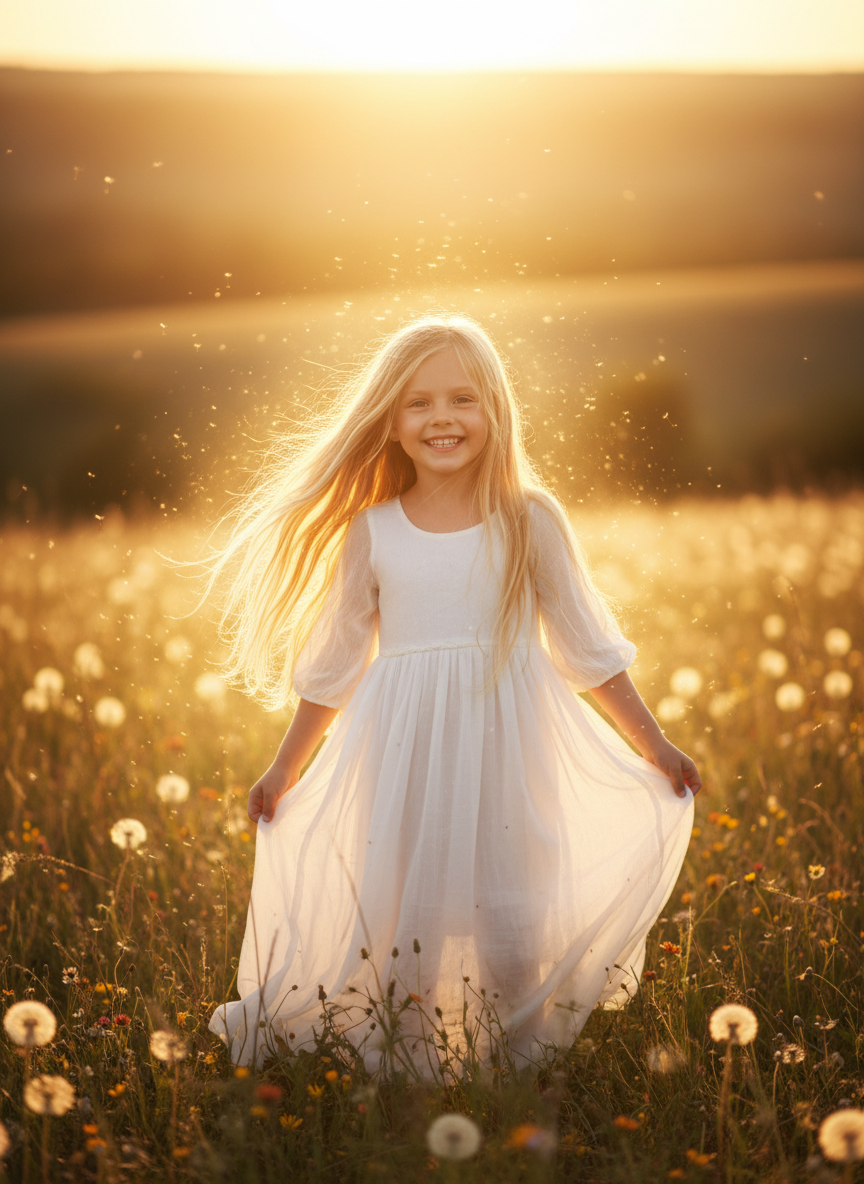
The stored prompt is only “A girl, with blonde hair, radiating sunshine.” That is a mood, not a brief. The model had to invent age, pose, clothing, camera distance, background, and whether “sunshine” means a weather icon or a lighting setup. The picture on this page is one of those guesses. If you click Make Same without editing, you are rolling the same dice, not directing a portrait.
Turn the mood into a five-part brief
Subject: a young woman with blonde hair, one distinguishing fact (freckles, a linen shirt, a bicycle). Pose: looking just off-camera, walking, seated on a step. Setting: a coastal path, a kitchen window, a wheat field—pick one. Light: “radiating sunshine” should become a direction: late-afternoon backlight with a bright rim on the hair, or open shade with a warm bounce, not a lens flare sticker. Medium: photograph with a short telephoto, or gouache, but not both at once unless you want a hybrid the model will over-smooth.
A replacement that still fits this image’s likely intent: “A young woman with blonde hair, three-quarter portrait, walking toward the camera on a dry-grass hill, late-afternoon sun behind her so the hair is a bright rim, shallow depth of field, natural skin texture, 3:4.” You can paste that on the homepage in text-to-image. The stored size here is 1024 × 1365, which is already a tall portrait; keep 3:4 or 4:5 instead of switching to 16:9.
Why blonde hair plus “sunshine” often fails
Hair highlights and sun as a disk both scream “bright yellow” to a model. You get fried whites, a halo, or a second sun. Name the exposure: “backlight, face filled by sky, no blown forehead.” If you want warmth, put it in the environment (golden grass, orange brick) rather than in the adjective “radiating.”
When to switch to image-to-image
Once you have a face and crop you like, stop using text-to-image for wardrobe tests. Use image-to-image and say “same person and camera, swap the hill for a city balcony, keep the backlight.” This page’s generation type is text2img, so Make Same will not attach a private photo you have on disk. Upload that photo yourself if identity matters.
Credits
Do not raise quantity until the brief has a setting and a light direction. Two failed moods cost the same as two finished portraits if they succeed. Policy blocks and true failures refund; ugly successes do not. Longer notes: prompt guide and credits.
Wardrobe, age, and camera distance this prompt never named
Because the original string does not mention clothing, the model will pick a default: often a sleeveless summer dress or a knit top, because those co-occur with “sunshine” in training data. If you wanted a coat, a school uniform, or a technical jacket, you must say so. Age is also unbounded. “Girl” can land anywhere from child to young adult. If you mean an adult, write “young woman” or an age range. If you mean a child, you still must keep the image non-sexual; we will not help you push that line, and the upstream filters will not either.
Camera distance is the other silent default. A three-word portrait prompt often becomes a beauty close-up. If you wanted an environmental portrait with hills in focus, say “waist-up” or “full body, small in the frame.” The file on this page is 1024 × 1365, which already suggests a poster crop. A close-up in that ratio looks like a magazine cover; a full-body in that ratio looks like a fashion lookbook. Pick one in the next prompt instead of hoping the next roll agrees with this thumbnail.
Color: sunshine is not a hex code
If the current picture is too yellow, that is the adjective doing too much work. Replace it with a time of day and a white-balance hint: “clear late day, neutral skin, warm only in the rim light.” If it is too pale, name the environment color (dry grass, terracotta wall) so warmth lives in objects, not in a global grade. Do not stack “golden hour, magic hour, god rays, volumetric sun” unless you want haze and a second sun disk.
The model listed on this page is nano-banana. Other engines will not reproduce this exact face. Treat Make Same as a starting prompt, then add the missing clauses before you spend the next credit. If you only change “sunshine” to “golden hour” and leave everything else blank, you will still get a lottery. Add setting, pose, and camera first; adjectives last.