Why this festival prompt works (and how to reuse it)
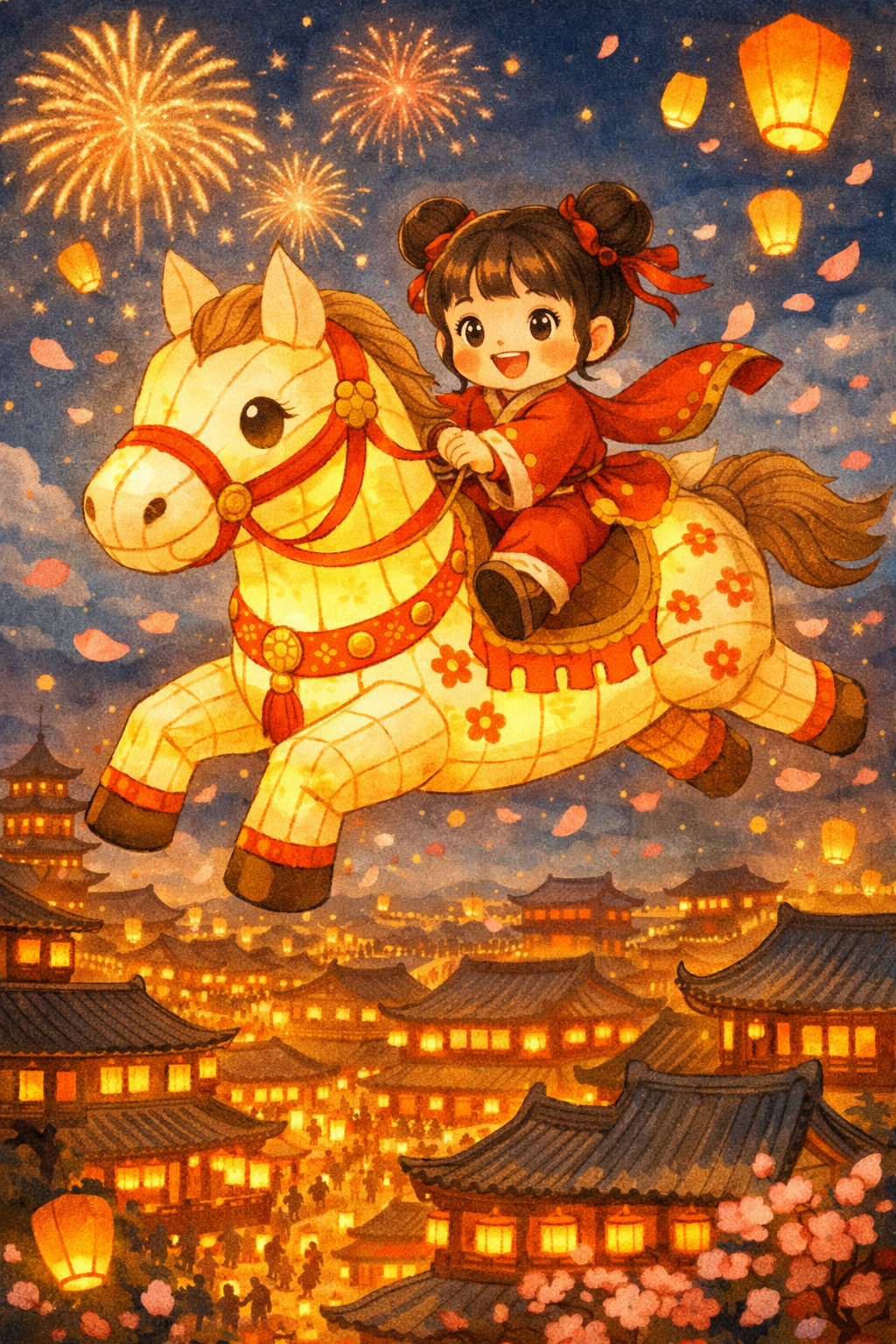
This page is a text-to-image example, not a photograph of a real parade. The prompt is long on purpose. It names a character (a fortune child in red, double buns), a vehicle that is also a light source (a giant horse-shaped paper lantern with a warm interior glow), a place (an old Chinese street at night), and a medium (whimsical, healing comic illustration, hand-drawn, warm tones). Aspect ratio 3:4 matches a tall poster: the horse comes toward you, architecture stacks behind, fireworks occupy the sky instead of empty margin.
Object list beats the word “traditional”
“Chinese-style” alone can mean ink wash, neon, or a generic dragon. This brief instead lists objects the model can latch onto: horse lantern, sky lanterns, fireworks, flower petals, a brightly lit architectural complex. If you borrow the structure, keep that habit. For a different festival, swap the objects (couplets and nianhua for lunar new year; lotus lanterns for a river night) instead of swapping the adjective.
Light is specified twice, which is useful
The lantern’s interior is “warm yellow.” The town is “brightly lit under the night sky.” Those are two layers: a practical on the subject and an ambient on the set. If you only say “night,” many models still render a gloomy blue street and the horse becomes a silhouette. If you only say “warm light,” you may get a studio gel and lose the festival. Naming both keeps the rider readable and the city alive.
What this engine still might invent
The prompt does not freeze anatomy. Horse lanterns in paper craft do not have real equine joints; the model may add a too-real horse neck or extra legs. If that happens, do not add “masterpiece.” Add a constraint: “stylized paper sculpture horse, simplified legs, no extra riders.” Hands on the child are another usual failure; “holding the lantern frame with both hands” is more effective than “detailed hands.”
Reuse on Nanomelon
Keep 3:4. Keep text-to-image unless you have a sketch of the lantern. Change one axis per rerun: wardrobe color, or time (blue hour vs midnight), or medium (woodblock instead of comic). The model recorded on this page is listed as openai; other engines will not match this look even with the same words. Failed policy checks do not take credits. For the general formula, see how to write prompts. To spend a credit on a cousin of this scene, use Make Same, then edit the object list rather than the whole paragraph.
More craft notes: Learn · models and credits · About Nanomelon.
Composition: why 3:4 and a horse coming toward you
A horse-shaped lantern in 16:9 would leave acres of empty street on both sides; the model would invent extra stalls and a second horse to fill them. 3:4 lets the lantern occupy the lower two-thirds and the fireworks the top, which is how paper-craft posters are usually read. “Galloping from the distance” is a camera note as much as an action: you are not beside the horse, you are in its path. If a rerun puts the horse in profile, you lost that sentence. Put it back at the front of the prompt, not the end.
Palette and the word “healing”
“Healing comic” is a useful style hint in East Asian illustration: round faces, clean outlines, low contrast pain, warm paper. It is also vague. If a result turns saccharine (oversized eyes, glitter, no architecture), keep “comic illustration” and add “visible brick, readable eaves, lantern as paper not plush toy.” If a result turns too realistic, the horse will look like an animal wearing a lamp, which breaks the craft object. Repeat “paper lantern sculpture” when that happens.
What not to copy blindly
Do not paste this entire paragraph into a commercial job and change only the child’s clothes. That is how galleries fill with twins. Steal the object-list method. Write a new list for your festival. If you need the same child for a series, switch to image-to-image after one keeper still, and describe only the new street. The recorded engine here is openai; a different model will ignore half the architecture clauses. Test quantity 1 until the horse has the right number of legs.